Most incident forms ask for the cause. CLUE, a new incident taxonomy from DNV and Equinor, asks a different question: what conditions made the action reasonable at the time? Here is what the CLUE incident taxonomy changes, what it has not yet proven, and what ship managers can test without adopting anything.
A note up front: I haven’t used CLUE in practice. This is a read of the published report and of how its ideas might apply on board and ashore. DNV, which co-developed it, also sells Synergi Life, the incident-management software CLUE is built into, so it is worth keeping that in mind.
The problem with the codes
Every incident report ends with a classification step: pick the causes from a list. The report’s argument is that this list, the incident taxonomy, is not a neutral filing system. It shapes which explanations feel credible, and therefore which corrective actions follow.
It points to widely used frameworks such as SCAT (almost 400 codes) and HFACS 8.0 (around 100), built for investigations and later used for routine reporting. Their wording leans on deficits: failure to follow procedure, lack of competence, incorrect action. The project team found that a few codes, often human-error related, dominated the data. In one customer experiment described in the report, simply changing the order of the codes changed how often each was used. When the usual explanation is the individual, the usual action is retraining or a re-brief, and the working conditions stay as they were.
What the CLUE incident taxonomy changes
- Neutral language. “Contributing factor” replaces “cause”. Categories describe conditions, such as available time, workload, conflicting priorities and availability of information, rather than shortcomings.
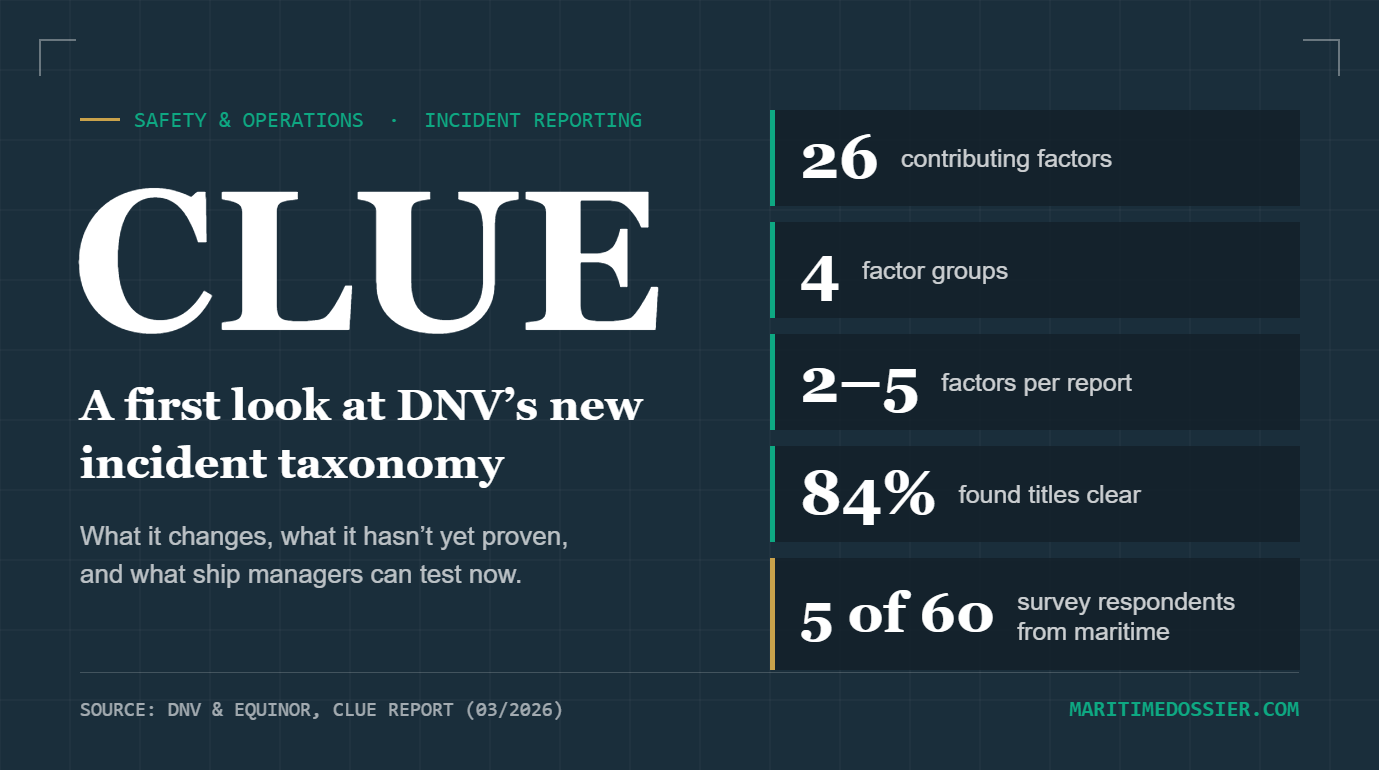
- 26 factors, one flat layer. They sit under four groups: task, individual, organisational, and workplace and equipment. There is no split between immediate and underlying causes.
- More than one factor per report. Reporters typically select two to five.
- A fuller narrative. With the causal layers removed, the description carries more weight. The report suggests a minimum of 120 to 180 words and describing roles rather than naming people.
- Actions that change conditions. Each action is tied to a tagged factor and framed as a testable hypothesis: if we do this, we expect that to change. The report’s phrase is to make “the desired way the easy way”.
Two choices stand out. “Risk perception”, a popular code, was left out because it is too counterfactual. “Gross negligence” was kept, but only for rare cases with clear evidence.
What it does not tell us yet
- It was not built for shipping. Of 60 survey respondents, 5 were from maritime, and Equinor and DNV staff made up 35. Maritime organisations, including the Norwegian Maritime Authority, are among those thanked for feedback, and DNV lists maritime among its target sectors.
- It was tested for clarity, not outcomes. 84% of respondents agreed the titles and descriptions were clear. Whether CLUE reduces repeat incidents is listed by the authors as future work.
- There is a trade-off. A flat structure means losing statistics on immediate causes such as procedural non-compliance. The authors expect the narratives, supported by text analysis including AI, to fill that gap.
- It does not replace root cause analysis. For severe events the report keeps the escalation path to a full investigation.
What to try before adopting anything
The ISM Code requires non-conformities, accidents and hazardous situations to be reported, investigated and analysed. It does not prescribe the categories, so form design is each company’s choice. CLUE’s questions can be put to any form:
- Take your last 20 corrective actions. How many are “retrain”, “re-brief” or “reissue the procedure”?
- Read your category list as a seafarer would. Does it describe conditions, or shortcomings?
- Do your reports say what the task, the time available and the information looked like, or only what went wrong?
- If you ever changed the form, what happens to old data? The report suggests keeping the legacy codes for history and applying the new ones to new incidents, accepting a break in the trend line.
The CLUE incident taxonomy is new, and unproven at sea. But its central question, what made this action reasonable at the time, costs nothing to ask of the next report you review.
For the wider argument about training and systems, see You can’t train your way out of human error.
Source: DNV and Equinor, “CLUE – Contextual Learning & Understanding of Events” (report, 03/2026). DNV overview: dnv.com

Capt. Gaurav Khanna is a Master Mariner, the founder of VragaMarine and the editor of Maritime Dossier. He spent 18 years at sea on product tankers and crude carriers, trading the Persian Gulf, the North Sea and the Baltic, before coming ashore in 2013. He then spent 13 years ashore with a Japanese ship management company, rising to Senior Deputy General Manager…
Views expressed are the author's own and do not represent those of their employer.
LinkedIn profile