Shipping has become exceptionally good at compliance. We have checklists for everything, procedures for everything, forms confirming the procedures were followed, and audits confirming the forms exist. And yet ships still run aground, engines still fail, cargo still shifts, and someone eventually asks the uncomfortable question: “But we followed the procedure, so what went wrong?”
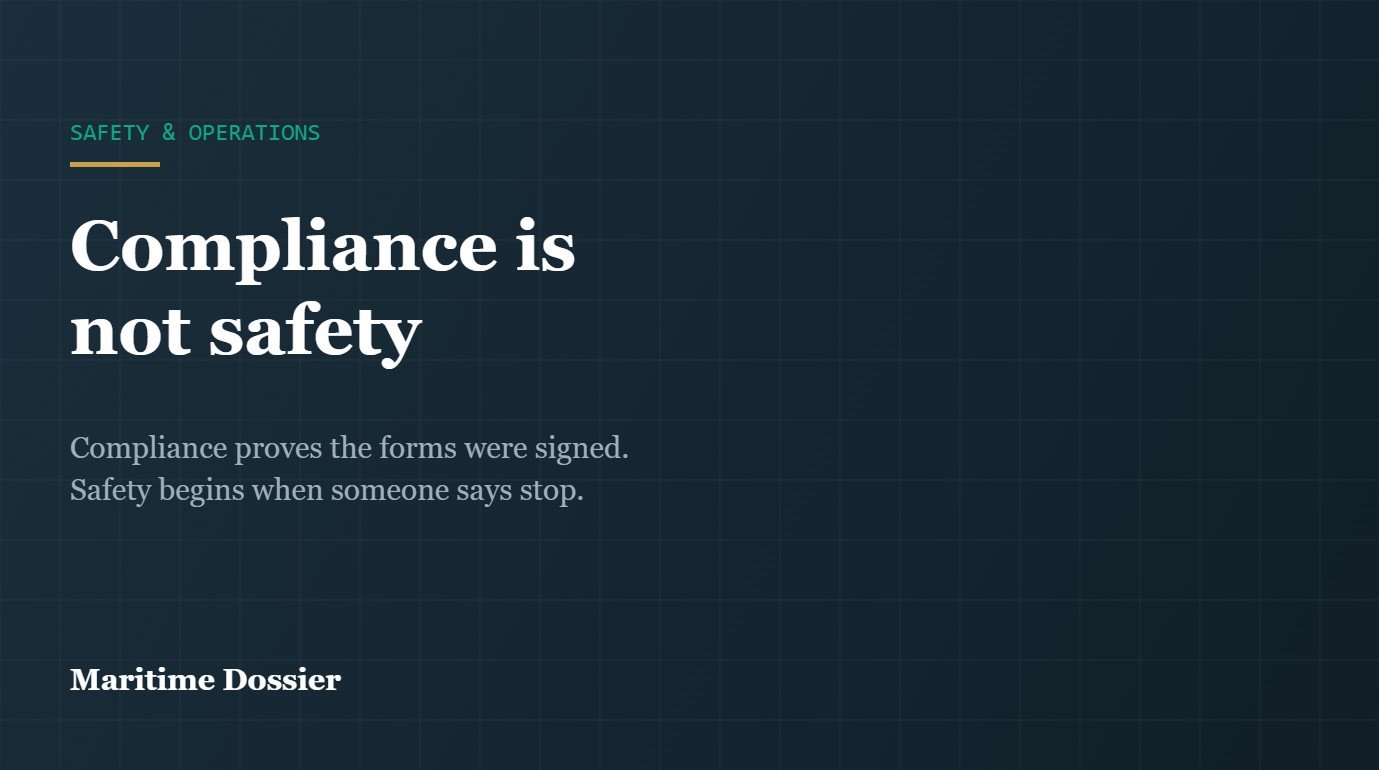
The answer is usually in plain sight. Compliance is not safety. On its own, compliance is evidence that the paperwork was completed before the accident happened.
The checkbox economy
Walk through any vessel today and you will find a remarkable system. Permits signed, toolbox talks recorded, risk assessments printed, checklists laminated. Every task begins with a form, and every form proves that someone thought about safety. In theory this is excellent.
In practice, something has happened over the past two decades: the form slowly became the task. Instead of asking “Is this safe?”, the process sometimes becomes “Is the checklist complete?” Those are not the same question.
The safety theatre problem
The phrase “safety theatre”, borrowed from the security world, is now used in aviation, medicine and elsewhere. It describes activities that make safety look stronger without making it stronger. Shipping has plenty of examples. The enclosed space entry form is signed, the toolbox talk is recorded, the risk assessment is filed, and everyone has technically complied.
But one question stays quietly unanswered: did the crew feel safe enough to stop the job if something felt wrong? Safety culture does not live in a binder. It lives in the moment someone says, “This doesn’t look right. Let’s pause,” and everyone else agrees.
The investigation time machine
After an incident, investigators arrive. They gather documents, examine procedures and check whether the crew followed the rules. Somewhere in the report appears a familiar sentence: “The procedure was not fully adhered to.” And too often that is where the story stops.
The deeper question is why the procedure failed to influence behaviour at that moment. Was it:
- fatigue?
- operational pressure?
- unrealistic procedures?
- time constraints?
- overconfidence?
- unclear authority?
Compliance can tell us which rule existed. It rarely explains why the rule stopped mattering when reality intervened.
Procedure inflation
Shipping has responded to incidents the same way for decades: add a new procedure, add a new checklist, add a new training module. Individually, every addition is logical. Collectively, the system becomes so dense that nobody can fully absorb it.
When people are overwhelmed with rules, they develop a survival strategy. They comply with what is visible and improvise the rest. That is the point at which compliance stops being safety and becomes documentation.
What procedures are for
None of this is an argument against procedures. Regulations matter, and checklists save lives. But they only work when they support human judgement rather than replace it. A good procedure helps someone make a better decision. A bad procedure simply proves that someone followed instructions before the accident happened. The difference is subtle, but it is the difference between learning and paperwork.
The real safety system
If you want to know whether an organisation is truly safe, do not start with the procedures. Start with the conversations.
- Can a junior officer question a decision without fear?
- Can a Chief Engineer delay a sailing without being quietly punished later?
- Can a Master say “we need more time” without triggering a commercial argument?
If the answers are yes, the procedures will work. If they are no, the procedures will provide a very detailed record of what went wrong.
The final line: compliance is not safety
Shipping will never eliminate checklists, and it should not. But we should be honest about what they are. Compliance alone does not prevent accidents; it documents that we tried. Safety begins earlier, in judgement, in communication, and in the quiet confidence that someone can speak up when the checklist says “go” but the situation says “wait”.
The checklist can prove the job was approved. Only people can prove it was safe.

Hittesh Gupta is Head of Casualty Investigation (APAC) and a Principal Surveyor with BMT, specialising in marine casualty investigations, cargo claims, technical disputes, and loss assessment. Based in Singapore, he provides independent expert support to insurers, P&I Clubs, shipowners, and legal counsel on high-profile maritime incidents across Asia and globally, with experience spanning container, bulk, tanker, and offshore operations.
Views expressed are the author's own and do not represent those of their employer.
LinkedIn profile