
Serious analysis on safety, audits, and the business of shipping — built to last.
Considered analysis and informed opinion on shipping from people who work in it — permanent, in-depth entries instead of another post that scrolls past.
Latest in the Dossier
View all entries →So you’ve spilled oil in port: six mistakes that hurt more than the spill
After an oil spill in port, how a vessel behaves in the first hours matters more than the quantity. Six common mistakes, from late notification to tidied-up records, and what to do in the first hour.
A.P.E.M. of a casualty: four stages of casualty management
The four stages of voyage planning, Appraisal, Planning, Execution and Monitoring, translate directly into casualty management. What each stage involves, and why it is a loop, not a line.
Beyond surveys: managing distressed cargo
Managing distressed cargo after a container casualty has little to do with survey work alone. Nine steps from risk profiling to cost control, from someone who has done it for twelve years.
 DOSSIER REF. MD-2026-233
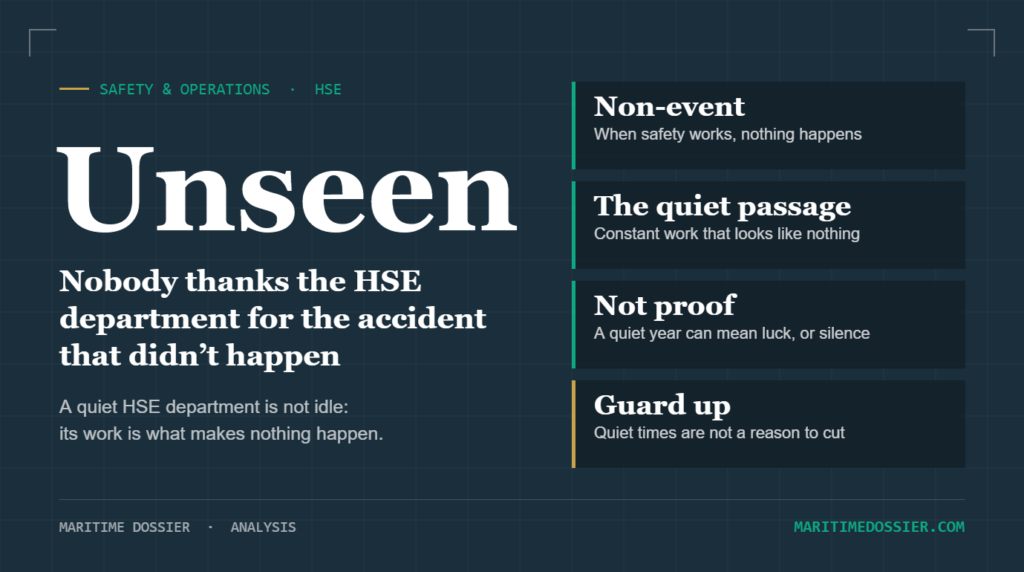
Nobody thanks the HSE department for the accident that didn’t happen
A quiet HSE department is not an idle one: its work is what makes nothing happen. Why a quiet year is not proof of safety, and why quiet times are when the guard should stay up.
Read the full dossierStart here
Five entries that show where Maritime Dossier is coming from: how we think about training, procedures, audits, safety work and incident reporting.
- Safety & OperationsYou can’t train your way out of human error
- Safety & OperationsWhen the whole fleet skips the step, the procedure is the finding
- Safety & OperationsNobody thanks the HSE department for the accident that didn’t happen
- Vetting & AuditsAccept every finding, however small
- Safety & OperationsCLUE: a first look at DNV’s new incident taxonomy
Topics
“If it isn’t useful to someone actually running a ship, a fleet, or a claim, we don’t publish it.”
Follow Maritime Dossier on LinkedIn
See each new entry as it is published.