A familiar investigation ends in a familiar place: the crew did not follow the procedure, and the cause is filed as human error. The corrective action is a toolbox talk, a re-brief, perhaps a reissued circular. The report is closed, and everyone involved feels the matter has been dealt with.
Then the same thing happens on a sister ship, with a different crew, who were also trained. This piece is about why that loop persists, and what managers can do instead of relying on capable people never to commit human error. These are practitioner observations, not research findings.
Two words we use without defining
Training. People arrive at a ship with different backgrounds, habits and ways of getting a job done. Training narrows that range. It takes people who have learned in different ways and brings them to one agreed way of doing a task, so the result does not depend on who happens to be on watch. That is its strength, and it is why standard procedures and drills matter. It is also its limit. A narrowed method works as long as conditions resemble the ones it was designed for. When they drift, the person holding it has less room to adapt, and some of the variety that was trained out may be exactly what would have coped.
Learning. Every investigation report promises that lessons will be learned. But a lesson noted is not a lesson learned. A fair test is whether something is different afterwards: a task redesigned, equipment changed, a decision made differently. If nothing is different, the organisation has recorded an incident, not learned from it.
Training is necessary, but it is a weak barrier
Nobody should argue against training. The ISM Code requires the company to ensure each ship is manned with qualified, certificated and medically fit seafarers (section 6), and STCW sets the baseline. But a qualification tells you what a person knows. It does not guarantee what they will do at 0300, short of sleep, with berthing delayed and three tasks competing for attention.
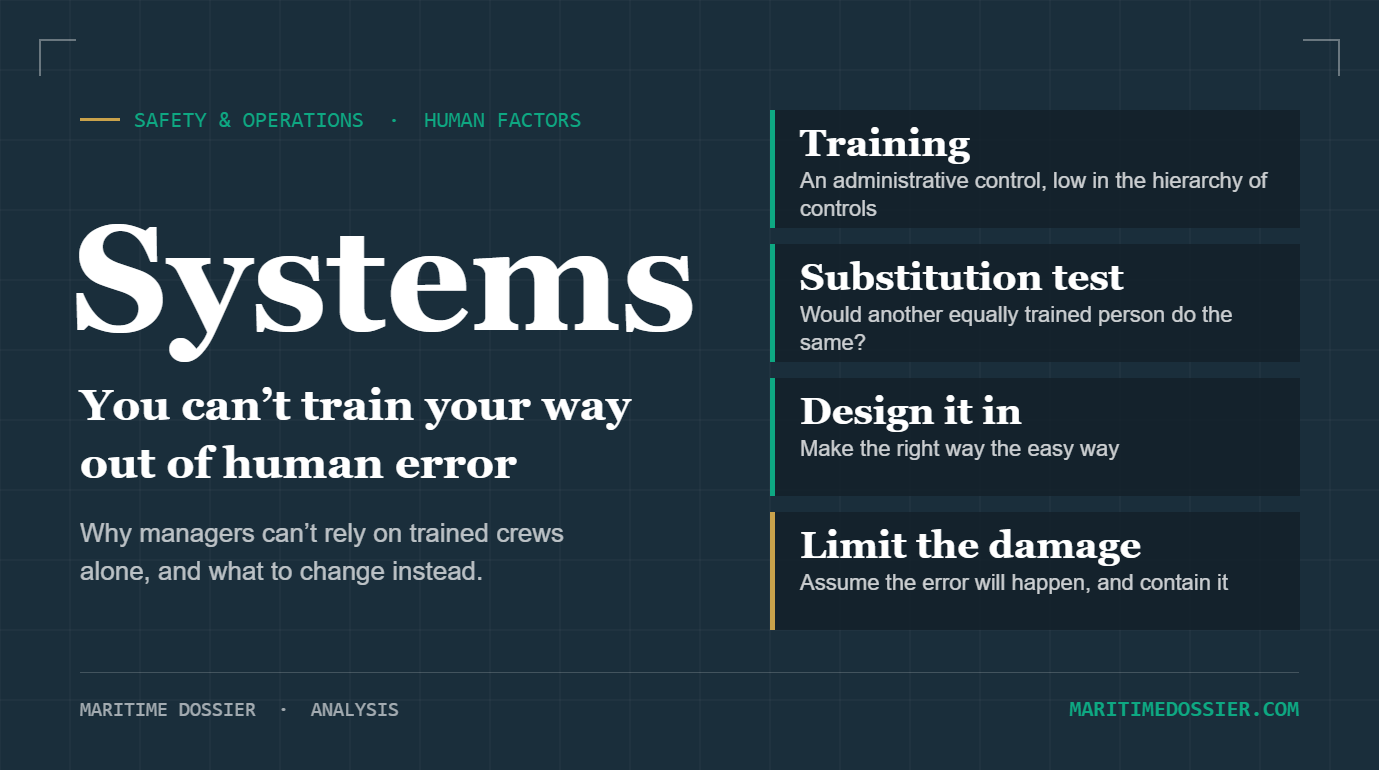
In safety engineering, training and procedures are administrative controls. They sit below eliminating the hazard, substituting it, or engineering it out, because they depend on a person remembering and choosing correctly every single time. A barrier that relies on perfect human performance, with no human error, is not much of a barrier.
Why human error persists in capable crews
- Conditions vary. Fatigue, time pressure, noise, weather and workload change from hour to hour. Competence does not switch off, but performance does vary.
- Crews change. Every crew change brings a different mix of experience, and new joiners meet your ship’s equipment, layout and habits for the first time. Training done ashore does not transfer automatically to this particular vessel.
- Priorities compete. Schedule pressure, charterer instructions and safety rules can pull in different directions, and the person on scene resolves the conflict in real time.
- Smart people adapt. A capable crew finds workarounds for poor equipment or an unworkable procedure and keeps the ship running. That adaptation is invisible until the day it fails, and then it is labelled a violation.
What to ask in an investigation instead
The aim is to understand why the action made sense to the person at the time. A few questions help:
- What did the task, the time available and the information look like at that moment?
- Would another equally trained and experienced person plausibly have done the same? This is often called the substitution test. If the answer is yes, the problem is not one individual.
- Has this happened before, on this ship or elsewhere in the fleet, and what was done then?
- Was the right way also the easy way? What made the wrong way quicker, simpler or more convenient?
- If the same error had been made and nothing had gone wrong, how many barriers were left?
These are close to the questions the CLUE report puts to incident reporting. I looked at it in a first look at DNV’s new incident taxonomy, and DNV’s own overview of CLUE is a good starting point.
Learning is a two-way street
When we say we learn from incidents, we usually mean information travels one way: the ship reports, the office analyses, a circular goes out. Real learning runs in both directions.
- Ship to shore. Does the office hear what actually happened, including the workaround, the shortcut and the pressure behind it? People report honestly only when past reports led to fixes rather than blame. If the last report ended in a reprimand or a generic reminder, the crew has learned something: not to report.
- Shore to ship. Does the ship get something it can use? A circular that says “be careful” is not feedback. A changed procedure, a repaired or relocated piece of equipment, extra manning for a known peak task, or an explanation of why a rule changed, is.
- Managers learn too. The gap between work as imagined in the SMS and work as actually done on board is usually where the lesson sits, and only the crew can show it to you.
And learning only counts if it ends in action. After the lesson, for each incident:
- Change something real: the task, the equipment or the conditions.
- Tell the ship what changed and why, so the people who reported it can see the result.
- Check after a few months whether the same error has become harder to make.
- Pass it to the other ships in the fleet, not only the one where it happened.
Shore up the system, not only the person
There are two jobs here: make human error less likely, and make its consequences smaller. For example:
- Design the task. Reduce steps, remove ambiguity, and standardise layouts and equipment across the fleet where you can. Fewer decisions at the point of work means fewer chances to get one wrong.
- Add a second line of defence for critical tasks. Independent verification, permit to work with physical isolation, and gas detection for enclosed space entry do not rely on one person being right.
- Limit the damage. Mark snap-back danger zones on deck during mooring, keep people out of the line of fire, and use guards and interlocks. The error still happens, but the injury does not.
- Fix the procedure. If a procedure is routinely bypassed, treat that as a finding about the procedure. Remove steps that add nothing and make the safe sequence the natural one.
- Make it easy to stop. Make it normal for anyone to pause a job, and make sure the company’s response to a stop is thanks, not questions about the delay.
None of this is new. What changes is that your corrective action list stops ending in “retrain” by default.
Where training still belongs
Training is most useful once the system has been made reasonable. Then it does its proper job: bringing everyone to the same safe way of working, and building what no design can fully remove, such as the judgement, communication and speaking up that catch human error, and rehearsing the emergencies you hope never to have. Test it, too. A drill that everyone passes tells you little about whether the crew can cope under pressure.
A test for your next corrective action
Before you close the next investigation, read its action list. If every action asks people to be more careful (retrain, re-brief, remind, reissue), it is an admonition, not a corrective action. Ask what single change to the task, the equipment or the conditions would make the same human error harder to make, or less costly when it is made.
Crews will always be the last line of defence at sea, because they are the ones there. The manager’s job is to make sure they are not the only one.

Capt. Gaurav Khanna is a Master Mariner, the founder of VragaMarine and the editor of Maritime Dossier. He spent 18 years at sea on product tankers and crude carriers, trading the Persian Gulf, the North Sea and the Baltic, before coming ashore in 2013. He then spent 13 years ashore with a Japanese ship management company, rising to Senior Deputy General Manager…
Views expressed are the author's own and do not represent those of their employer.
LinkedIn profile