Read enough incident reports and a pattern appears. The finding is that the crew did not follow the procedure. The action is retraining. A year later a different crew on a different ship does the same thing, and the report reads the same.
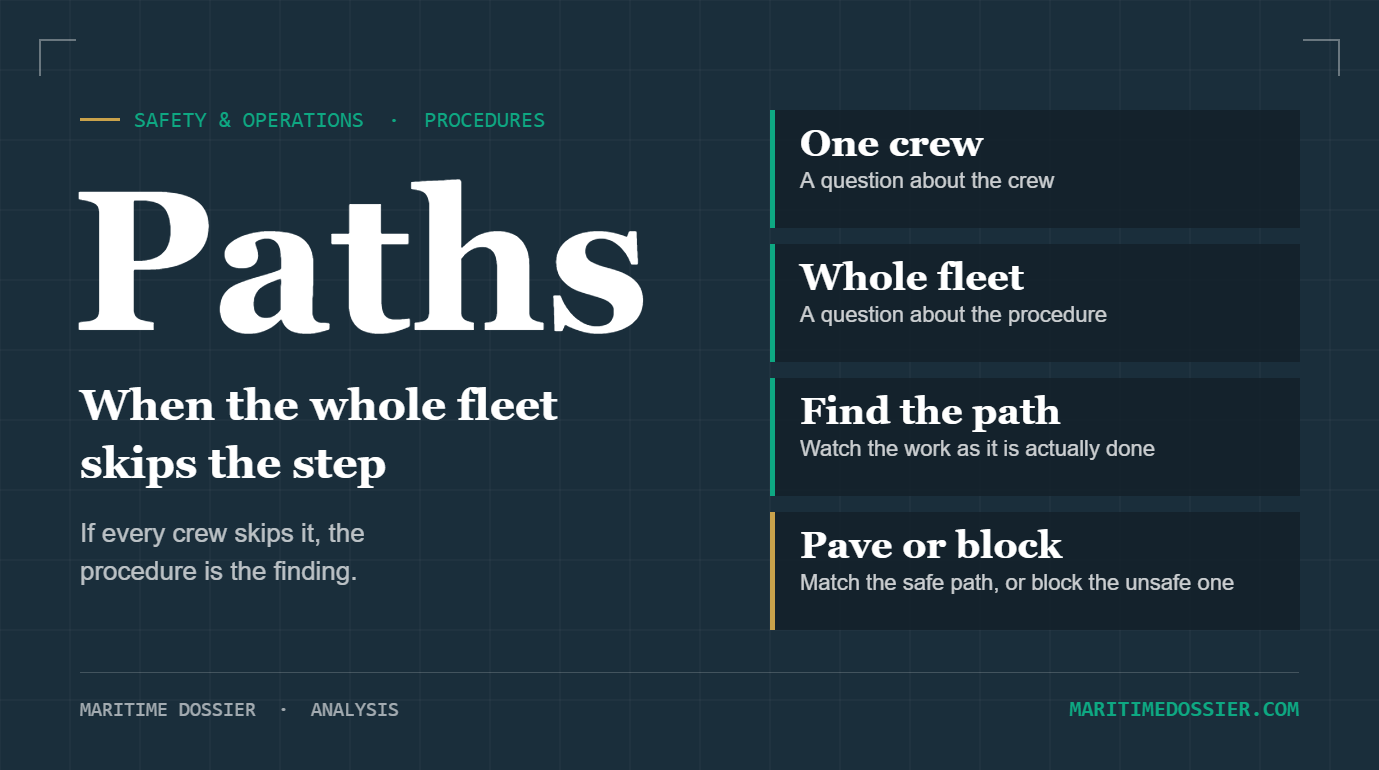
One crew skipping a step is a question about that crew. Every crew skipping the same step is a question about the procedure. This piece is about telling those two apart, and what to do about the second, using the idea of desire paths. It follows on from You can’t train your way out of human error, which argued that managers cannot depend on trained people alone.
One crew, or the whole fleet?
When non-compliance is rare and scattered, individual factors may well be involved. When it is common across ships, crews, ranks and years, individual explanations stop working. Nobody recruits a fleet of people who all happen to be careless in the same way. A pattern that survives changes of crew is a property of the system: the procedure, the equipment, the time allowed, or the way the task is really done.
That gives managers a practical test. Before writing “procedure not followed”, ask how many people have done the same thing, and how often. Your internal audits, near-miss reports and walk-rounds probably already hold the answer. If it is “most of them”, the procedure is the finding.
What a desire path is
Campus planners know this pattern as a desire path: the worn line across the grass where people actually walk, whatever route the paving intended. The path exists because it is the most efficient route for the people using it, and no sign will reliably keep them off it. Some campus designers now wait to see where people walk before deciding where to pave (an overview of desire paths in campus design).
Procedures have desire paths too. When a step is slow, awkward, out of sequence, or needs equipment that is not where the procedure assumes, people find the route that works, and it becomes the normal way. Safety writers have made the same comparison for safety technology that is hard to use: it gets bypassed (an example). Retraining sends people back to the paved route. It does not change why they left it.
An example from the bridge: the radar performance monitor
One case I keep meeting in VDR audits is the radar performance monitor check. Many SMS procedures require officers to run it and log it once per watch. When the radar log is compared with the VDR recording, the log often shows the check completed while the recording shows no screen activity at that time.
Read as individual behaviour, that is a false log entry. Read as a pattern across ships and crews, it is a desire path. The rules themselves do not set that frequency. SOLAS Chapter V, Regulation 19 asks for radar to be maintained to minimise malfunction, and the ICS Bridge Procedures Guide says the quality of the radar picture should be checked regularly, which can be automatic where a performance monitor is fitted. The once-per-watch requirement comes from the company’s own SMS, often written around magnetron radars and applied unchanged to solid-state sets that run continuous built-in diagnostics. In busy water the manual check cannot be done meaningfully, so the log gets filled in.
Retraining officers would change nothing here. The fix is to change the procedure: keep a real check for magnetron radars when conditions allow and record what was actually observed when they do not, and for solid-state radars rely on the automated diagnostics, reviewed through the planned maintenance system. I set out the detail in my article on the radar performance monitor.
There is a warning in it too. In my experience, ships where this entry is routinely false often show other doubtful entries as well, such as position fixing, hours of rest and permit to work. Once recording something undone becomes normal, it spreads.
Find the real path
- Watch the work as it is done. Walk the task with the crew and ask them to show you how it goes on a busy day. The gap between work as imagined in the procedure and work as done on board is where the finding sits.
- Ask why, not who. “What makes this step hard to follow here?” gets a different answer from “Why didn’t you follow it?”.
- Look for the signs. Steps that are always ticked but never observed, and the same workaround turning up on several ships, are paths.
- Compare ships. If one ship follows the procedure comfortably, find out what is different about its layout, manning or equipment.
Then pave it, or block it for a stated reason
Once you know where the desire paths run, there are three honest answers:
- If the real path is as safe as the intended one, pave it. Change the procedure to match. The paperwork gets shorter and compliance stops being a fiction.
- If the real path is nearly safe, improve it. Add the missing control, such as a guard, a check or a rest point, so the natural route is also a safe one.
- If the real path is unsafe, block it properly. A reminder will not do. Change the layout, the equipment or the sequence so the unsafe route is hard, and tell the crew why it matters.
A caution
None of this means every shortcut is acceptable, and desire paths are not automatically safe. Some rules exist because of hazards the person doing the job cannot see: stored energy, atmospheres you cannot smell, failures that only appear once in many years. A shortcut that has always worked has not proved it is safe. And a small number of violations are deliberate and serious; frameworks such as CLUE keep a narrow exception for them. The point is to ask why the path exists before deciding what to do about it.
Work with people, not against them
Herding people along a route they do not want to take needs constant effort, and it fails the moment supervision relaxes. Designing the route so the safe way is also the easy way takes effort once. Crews will always choose the route that works for them, and desire paths are information, not defiance. The manager’s job is to make sure that route is one they would be comfortable explaining to an investigator.
So the next time a report says “procedure not followed”, ask one question before anything else: how many others do the same?

Capt. Gaurav Khanna is a Master Mariner, the founder of VragaMarine and the editor of Maritime Dossier. He spent 18 years at sea on product tankers and crude carriers, trading the Persian Gulf, the North Sea and the Baltic, before coming ashore in 2013. He then spent 13 years ashore with a Japanese ship management company, rising to Senior Deputy General Manager…
Views expressed are the author's own and do not represent those of their employer.
LinkedIn profile