

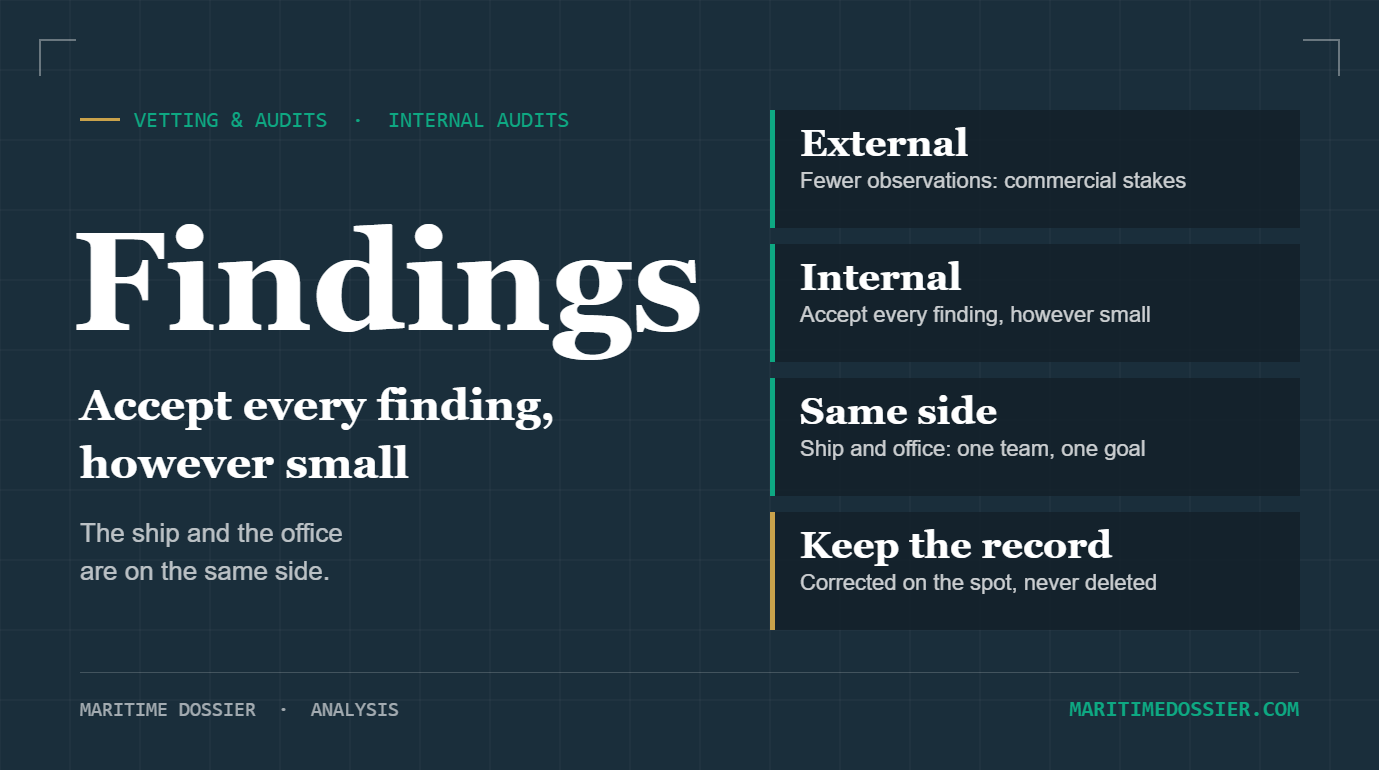
The word “finding” means two different things depending on who is looking. In a PSC inspection, a SIRE inspection or a RISQ assessment, an observation can carry commercial consequences for the ship and the company, so we do what we reasonably can to keep them down. In internal audits, a finding is not a mark against the ship. It is a problem found early, by people on the same side as the ship, at almost no cost.
This piece argues that internal audits and company audits should accept every finding, however small, and that doing so is the most reliable way to do well externally. It also answers a question that comes up in every audit team: if the ship fixes the problem before the closing meeting, should the finding stay in the report?
Why fewer is the right goal for external inspections
Nobody is wrong to want clean external inspections. Observations in PSC, SIRE and RISQ can affect how a ship is regarded and how easily it is accepted, so companies prepare, correct what they can and try to arrive with as little as possible to find. That is a sensible response to those incentives. This is a practitioner’s description of how the commercial side works, not a statement of any scoring rule.
Internal audits are the first barrier
The way to arrive at an external inspection with little to find is to have found it first. Internal audits are the first barrier, and they are also the cheapest. The ISM Code requires the company to carry out internal safety audits on board and ashore (section 12), precisely so that problems are found by the company before anyone else finds them. A problem caught by the Master, the Chief Officer or a superintendent costs a corrective action. The same problem caught by an external inspector can cost far more. In the language of the earlier piece on training, it is the barrier that stops the error before the others are tested.
In an article on ship navigational audits I argued that most fleets have inverted the audit hierarchy. The most frequent audit, run by the ship’s own officers and carrying the lowest consequence, produces the thinnest findings, while external audits catch what should have been caught inside. Findings, as I put it there, migrate outward through the audit chain.
The ship and the office are on the same side
Too often an audit turns into a contest. The ship tries to show it has little to find, and the office or the auditor tries to show it has looked hard. It should not be a contest. The ship and the office want the same thing: for the ship to arrive at its next PSC, SIRE or RISQ with nothing to find. A finding raised in internal audits is the cheapest help either side can give the other.
The ship that accepts a finding without defensiveness is protecting itself. The office that receives it without blame is protecting the ship. When the Master fears the finding, it gets hidden, and a hidden finding surfaces outside, where it costs the most. The pressures I described in that article are symptoms of the same mistake. Masters may under-report so as not to look incompetent, and superintendents may soften observations to protect relationships. Both come from treating the audit as a verdict instead of as help.
The same applies to a quiet audit report. A ship whose internal audits keep finding one or two minor items deserves a question, not a congratulation, because it may mean the audit was shallow or that people have learned findings are unwelcome. This is the same point as in the piece on the quiet year: an absence of findings, like an absence of incidents, has more than one explanation. And a long list of internal observations is not evidence of a poorly run ship. It is often evidence of an honest audit.
Fixed before the closing meeting: does the finding stay in the report?
Take the question that started this piece. A defect is found during the audit and the crew fixes it before the closing meeting. Some say it should come out of the report, because listing it pads the count and harasses a crew that has already done the right thing. Others say it should stay, because removing it hides a condition that may exist on sister ships.
For internal audits I would keep it, however small, and record it as corrected during the audit. There are four reasons.
- Fixing the item is not fixing the cause. Quality management distinguishes a correction, the action that fixes a detected problem, from a corrective action, which removes its cause. The ISM Code expects the second: procedures to ensure non-conformities are reported, investigated and analysed to improve safety, and corrective action that includes measures intended to prevent recurrence (sections 9.1 and 9.2).
- The record matters. ISO 9001 expects an organisation to retain documented information on the nature of a nonconformity and the actions taken. A deleted finding leaves nothing to learn from.
- A report should be a fair presentation. ISO 19011 describes fair presentation as the obligation to report truthfully and accurately, so that findings and reports reflect the audit activities. A report from which a finding has been removed no longer reflects what the auditor saw.
- Other ships may have the same condition. Only a recorded finding can be passed on to the rest of the fleet.
The objections have answers that do not involve deleting anything. Padding is handled by classification: a small item is recorded as minor, corrected on the spot and closed, so the cost to the ship is a line in the report and not a mark against its name. Harassment is handled by how the company uses the report. A finding that was corrected on the spot should never count against the ship as if it were still open, the count should never become a league table, and the ship that found the problem before the auditor did should be credited for it.
How to tell it is working
The number of internal findings is not the score, in either direction. These are better signs:
- Repeat findings fall. The same condition recurring on the same ship, or across the fleet, is the clearest sign that corrective action is not reaching the cause.
- Findings close quickly, and the closure is verified.
- A larger share is identified by the ship itself before the audit begins.
- External observations fall over time. I suggested checking whether internal findings correlate with later SIRE and PSC results.
- Fleet comparison replaces single-ship scores. A Master judged on one ship’s number has every reason to keep it low. Comparing across the fleet removes that incentive.
In the language of the UK Health and Safety Executive’s guidance on safety indicators, internal findings work as leading indicators, routine checks that controls are working, and external observations as lagging ones, showing a failure after the event. That is my application of the framework to audits, not something the guidance says about shipping.
The condition: it must be safe to find things
Accepting every finding only works if the response is help, not blame. If a Master is judged on the count, the count will fall, and the findings will move to the places where they cost the most. This is the two-way street from the earlier piece on learning: a crew that finds and reports a problem has to see something change.
The ship and the office are on the same side. Accept every finding, however small, and fix it. The external inspector will then have less left to find.
Sources
A note on the sources: the ISM Code and ISO references are paraphrased, and the wording of the standards should be checked against the originals. The ISO standards were not read in full for this piece.
- International Maritime Organization, International Safety Management (ISM) Code, sections 9 (Reports and analysis of non-conformities, accidents and hazardous occurrences) and 12 (Company verification, review and evaluation).
- ISO 9000:2015, Quality management systems: Fundamentals and vocabulary (definitions of correction and corrective action).
- ISO 9001:2015, Quality management systems: Requirements, clause 10.2 (Nonconformity and corrective action).
- ISO 19011:2018, Guidelines for auditing management systems, clause 4 (Principles of auditing).
- Health and Safety Executive (2006), Developing process safety indicators (HSG254), first edition.
- Khanna, G., Ship navigational audit, VragaMarine.

Capt. Gaurav Khanna is a Master Mariner, the founder of VragaMarine and the editor of Maritime Dossier. He spent 18 years at sea on product tankers and crude carriers, trading the Persian Gulf, the North Sea and the Baltic, before coming ashore in 2013. He then spent 13 years ashore with a Japanese ship management company, rising to Senior Deputy General Manager…
Views expressed are the author's own and do not represent those of their employer.
LinkedIn profile